News
IMO / REGULATORY MATTERS
A game changing moment for shipping and the bunkering sector
The outcome of the 83rd session of IMO’s Marine Environment Protection Committee (MEPC 83) was expected to be a momentous conclusion to nearly two years of negotiation and certainly it proved to be so. The decision to approve draft amendments to MARPOL Annex VI to make regulations to enact the “IMO Net-Zero Framework” came at what are possibly some of the most difficult headwinds for multilateralism with both actual and trade wars prevailing leading to global governance processes being put under tremendous strain.
IMO’s net-zero framework, were it to be adopted in October, provides a signal that global action to address anthropogenic climate change continues to move forward, albeit not at a pace to keep the Earth’s average surface temperature increase to the 1.5oC limit. Nevertheless, it will be a game changer in that it will trigger the start of the energy transition of international shipping. In this regard, the significant implications for stakeholders across the marine fuel value chain cannot be understated. I shall explore some of those in this edition.
I have used this column before to highlight all the significant policy issues, many of them highly political, that needed to be reconciled in order for an agreement to be achieved. Whilst a consensus could not be gained, as those many policy issues proved too difficult to find a compromise satisfactory to all, sufficient IMO Member States were satisfied to support the decision to “approve” the draft amendments to MARPOL Annex VI. Indeed roll-call voting is a rare occurrence in IMO whereby Member States that are registered as “present” in the meeting are called one at time in alphabetical order to express “Yes”, “No”, or “Abstain”. Those Member States not present are not counted. Indeed, the last time your correspondent recalls a roll-call vote happening was in 2011 when the amendments to MARPOL Annex VI on energy efficiency regulations (EEDI/SEEMP) were “adopted”.
With 63 Member States voting ‘yes’ and 16 ‘no’ the requirement of just a simple majority for a decision of the Committee was easily obtained. However, when it comes to the “adoption” of the draft amendments in October the equation changes. This is because adoption is a matter for the 108 Contracting Parties to MARPOL Annex VI only. Also, the treaty requirement is for the decision to be supported by a two-thirds majority of those “present and voting”. In other words, a working majority would be 72 Parties.
It is unlikely that all Parties would be present. Also, not all of those who voted this time are Parties and eligible to vote in October. In the end I do expect the amendments to be adopted as there is apparently clear political will for the measures to be taken forward.
What does this mean for marine fuel? To some degree an insight into the implications has already been gained from the implementation of FuelEU Maritime. Whilst many businesses engaged as suppliers or buyers have developed their strategies to achieve compliance and gained valuable operational experience of implementation, several questions remain not least about the availability of fuels to comply with this regional rule let alone the future international rules that require global availability. In the short term, at least, the new IMO rule will add to the uncertainty on which fuels will be the winners, and which will struggle to gain traction. The result will be for many to stick to tried and tested solutions for compliance and to hedge on the basis of the current known risks, both financial
and operational.
This uncertainty prevails as key parts of the IMO rule remain to be defined or have been agreed only for a relatively limited period with the aim to review before the end of the decade. A clear example of the former is that the all-important quanta remain to be agreed for the “rewards” for those using “zero or near-zero” (ZNZs) fuels, technologies and energy sources. It is already apparent that those rewards will need to be substantial to support the business case for shipowners to consider the procurement of those ZNZs in the next decade especially whilst availability, especially of fuels, remains uncertain. Put simply until the quanta are agreed those making the business decisions cannot make those decisions on the basis of the risks being priced. A decision on the rewards may not be forthcoming until Spring 2026 giving, in theory, under a
year before entry into force with the
GHG intensity requirement beginning
1 January 2028.
The uncertainty is compounded, and an example of where agreement has been made for a limited period only, as the cost of “remedial units” that ships will need to purchase to come into compliance where they do not meet the “Direct Compliance Target” for annual GHG intensity of the energy used by the ship has been set for the first two reporting periods only. A decision on the cost of remedial units for the reporting periods starting 2031 and onwards is expected by 1 January 2028.
The development of future strategies for anyone producing, supplying, selling and buying marine fuels will in many respects be determined by when these uncertainties are addressed.
A major decision was the confirmation that the governance of marine fuel will move onto a “Well-to-Wake” basis. Physical suppliers will be at the fulcrum of this new governance regime and may become solely responsible for providing the required information to enable the ship to calculate the GHG intensity of energy used on board the ship – the basis for calculating compliance! IBIA engaged in the detailed negotiations of the new “Sustainable fuels certification schemes” framework and ensured that the required information to be documented in a “Fuel Lifecycle Label” would not need to be provided at the time fuel is supplied to the ship but rather “may accompany the bunker delivery note”. This outcome was the result of comments forwarded to IMO Member States by IBIA that emphasised the importance for the new governance regime of implementation, those comments being based on feedback received from IBIA members during an online meeting held to discuss proposed amendments to the BDN in March. I would like to thank all those who provided their views and the IBIA Board for their support to ensure this important matter was appropriately reflected in the final draft of the regulations.
The previous example clearly demonstrates the value of consultative status at IMO for IBIA’s members. As a global association we have less of an opportunity to provide input to specific jurisdictions such as the European Union, but the recently established European Regional Board provides scope for IBIA to engage in the debate in the EU. Part of that debate will be the alignment (or not) of the EU rules with the IMO rules. EU instruments provide for a review once the global requirements are confirmed. In a statement released welcoming the outcome of MEPC 83 the European Commission reflected this review as follows: “The Commission will also assess the new global measure to see how it interacts with current EU maritime related regulations, maintaining environmental integrity while avoiding significant double burden.” Note the statement does not read ‘while avoiding any double burden’?! It is expected that there will be pressure on the EC to confirm their position on alignment before the IMO rule is adopted. This is because non-EU IMO Member States, both supportive of and against the IMO rule, will wish to understand the implications for their ships before they cast their vote in October.
Consideration of carriage of greater than B25 biofuels by bunker vessels
Finally, I am pleased to report that IBIA’s efforts to highlight the incongruity on the issue of the carriage of greater than B25 biofuels by MARPOL Annex I certified bunker vessels led to a successful outcome. Following consideration and recommendation by PPR 12 in January, MEPC 83 approved MEPC circular Interim guidance on the carriage of blends of biofuels and MARPOL Annex I cargoes by conventional bunker ships (MEPC.1/Circ.917) that permits the transport of blends of not more than 30% by volume of biofuel, providing all residues or tank washings are discharged ashore unless the oil discharge monitoring equipment (ODME) is approved/certified for the biofuel blend(s) being shipped. The interim guidelines confirm that an IOPP certificate showing “oil tanker” issued to a conventional bunker ship carrying blends between 25% and 30% biofuel or synthetic fuel does not need to be modified.
Wishing you all a fair wind and
safe seas.
Edmund Hughes
Happy World Oceans Day! Today, we celebrate the incredible oceans that sustain life, regulate our climate, and connect communities across the globe. As a global community, we reaffirm our commitment…
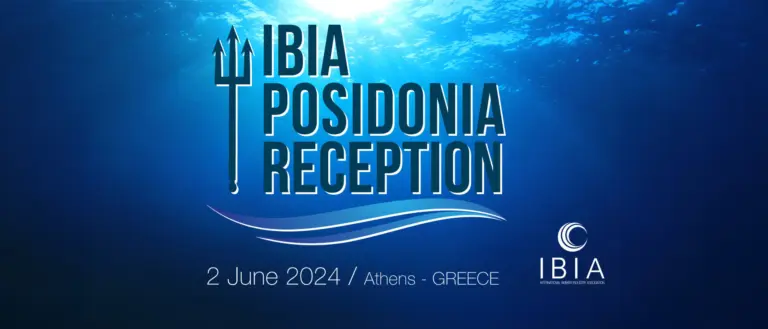
IBIA successfully hosted a reception on Sunday, 31 May, at the Official Residence of the South African Embassy in Athens, bringing together key stakeholders from across the global bunker, shipping, and marine energy sectors ahead of Posidonia 2026. Held in the gardens of the South African Ambassador’s residence, the event…

World Bunkering’s editor David Hughes recently had the opportunity to ask newly elected IBIA Chair Adrian Tolson about his career in bunkering, views on the current market and global challenges, and his hope…
Seafarers are the unsung heroes, the backbone of shipping. They keep global trade moving. Around 80% of global trade is carried by sea, meaning food, fuel, medicine, electronics and everyday goods people rely on are transported largely thanks to their work. Without them, supply chains would stall very quickly. Last week, IBIA Executive Director Alexander…